
Customer Innovation Score
What are your customers expectations of your company solving their evolving needs?
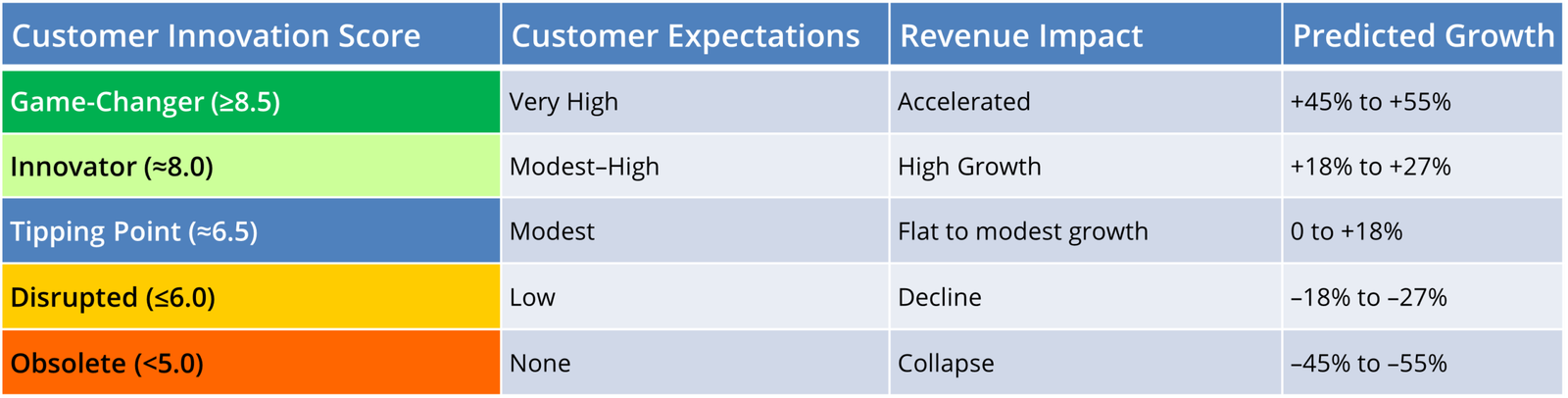
The answer (on a scale of 1-10), profoundly influences your product strategy, positioning, customer retention, revenue, and growth. If you track this well, you are far more likely to stay relevant—and win in fast-moving markets.
Your Customer Innovation Score is a ground-breaking single metric that measures how relevant your product is, builds high levels of customer trust, and uncovers unmet needs you can act on.
Your score analysis gives you deep insight into customer expectations so you can achieve 10 important objectives.
1. Guide Product Innovation
Align development with real demand.
2. Strengthen Competitive Differentiation
Being perceived as an innovative problem solver sets you apart from commodity competitors. This directly impacts pricing power and market positioning.
3. Improve Customer Retention and Reduce Churn
Customers who expect innovation will leave if you stagnate. Measuring expectations lets you spot misalignment early before customers quietly leave.
4. Prioritize Customer Experience and Value Delivery
Innovation isn’t just about features—it’s about solving problems better. Measuring expectations shifts focus from “feature output” to “problem-solving outcomes.”
5. Support Go-To-Market and Messaging Strategy
Marketing teams need to know how customers perceive the company. Prevents brand disconnect between what you claim and what customers believe.
6. Identify Growth Opportunities (Upsell & Expansion)
Measuring expectations helps identify which segments are ready for expansion vs. those that need education or trust-building.
7. Align Internal Teams Around Customer Value
Different teams often have different assumptions. Measuring expectations creates a shared reality, aligning product, marketing, and leadership decisions.
8. Validate (or Challenge) Strategic Direction
Many companies aim to innovate. Measuring expectations tells you; Whether your strategy is credible or if there’s a knowledge gap to close first.
9. Increase Customer Lifetime Value (LTV)
Innovation perception = long-term revenue stability.
10. Detect Market Shifts Early
Customer expectations change quickly. Measuring expectations helps you keep ahead rather than reacting late.